Engineering
In heavy engineering and fabrication industries, welding sits at the heart of structural integrity and product performance. However, ensuring consistent welding quality across complex shop-floor environments often remains a major challenge — driven by human variability, fragmented inspection processes, and limited traceability.
Poor welds can lead to costly rework, non-compliance with industry standards, and, most critically, product failures in the field. Traditional paper-based inspection logs and disconnected quality checks often fail to capture real-time defects or systemic root causes.
Our Quality Control Protocols with Shop Welding Enhancement solution transforms this scenario by fully integrating welding processes with AI-powered defect detection, structured inspection protocols, digital documentation, and actionable analytics — ensuring every weld meets design intent, regulatory compliance, and safety standards with complete traceability.
Key Use Cases & Capabilities
1. Centralized Storage of WPQR/WPS Documentation
Digitally store and manage Welding Procedure Qualification Records (WPQR) and Welding Procedure Specifications (WPS) in a secure repository.
Benefits:
-
-
Instant access for audits, compliance checks & production teams
-
Eliminates paperwork and version control issues
-
Quick retrieval for inspections and approvals
2. Automated Qualification Expiry Alerts
Set automated expiry notifications for welder certifications, WPS validations, and qualification renewals.
Benefits:
-
-
Prevents unqualified personnel from performing critical welds
-
Ensures continuous regulatory compliance
-
Simplifies workforce certification management
3. Pre/Post-Weld Inspection Checklists
Digital inspection templates ensure consistent data capture for pre-weld preparation and post-weld evaluations.
Benefits:
-
-
Eliminates checklist variations across inspectors
-
Ensures 100% coverage of inspection points
-
Early detection of potential weld quality risks
4. In-Process Weld Inspections
Enable real-time inspections during welding operations, capturing parameters such as heat input, travel speed, and filler material usage.
Benefits:
-
-
Identify deviations early before weld completion
-
Reduce scrap and rework costs
-
Continuous process control aligned with design specifications
5. Root Cause Analysis & Defect Trend Monitoring
Use AI-powered defect detection and historical analysis to identify recurring quality issues, material variances, and operator errors.
Benefits:
-
-
Data-driven improvement of welding processes
-
Early identification of systemic issues
-
Supports continuous improvement and Six Sigma initiatives
6. Weld Repair & Rework Management
Digitally log, track, and analyze weld repairs with full traceability from defect identification to corrective action closure.
Benefits:
-
-
Reduce repeated repair cycles
-
Detailed analytics for cost-of-quality reporting
-
Clear accountability and audit trails
Role-Based Access & Interfaces
Role
|
Key Actions & Interface
|
| Welding Supervisor |
Schedule inspections, assign qualified welders, review inspection results |
| Quality Inspector |
Conduct digital inspections, record findings, flag defects |
| Production Manager |
Monitor quality KPIs, track repair activities, authorize work releases |
| Compliance Officer |
Access audit-ready documentation, verify certifications, generate compliance reports |
| Admin |
Manage user roles, configure checklists, update WPS database |
Before vs After – Problem Solving Matrix
Old Problem
|
New Digital Solution
|
| Paper-based weld records |
Centralized digital WPQR/WPS repository |
| Missed welder qualification expiries |
Automated certification alerts |
| Inconsistent inspection processes |
Standardized digital checklists |
| Reactive defect management |
AI-powered real-time defect detection |
| Poor traceability for repairs |
Full rework tracking with audit trails |
Analytics & Dashboards
-
-
Weld Defect Heatmap
-
Certification Expiry Dashboard
-
Rework & Repair Cost Analysis
-
Inspection Compliance Rate
-
Operator-wise Defect Frequency
-
Root Cause Categorization Reports
Use Case Impact – Real Industry Examples
Example 1: Offshore Platform Fabricator
Example 2: Heavy Equipment Manufacturer
Example 3: EPC Contractor for Power Plants
Why Choose This Solution?
-
-
Fully digitizes welding quality management lifecycle
-
Seamless ERP, MES, and PLM integration
-
Enables AI-powered predictive quality improvement
-
Supports global compliance standards (ASME, AWS, ISO)
-
Scalable for multi-factory and multi-project environments
-
Increases throughput while reducing cost of quality
Get Started
Looking to build world-class welding quality programs with full digital integration? Let us show you how our Shop Welding Enhancement Solution can reduce defects, control costs, and safeguard compliance.
Engineering
Industrial assets—whether in heavy engineering, oil & gas, power plants, or aerospace—demand unrelenting reliability. Failure to detect hidden flaws early can escalate into catastrophic breakdowns, safety hazards, and costly downtimes. Traditional Non-Destructive Evaluation (NDE) methods, while effective, often suffer from fragmented data capture, paper-based reporting, and subjective interpretations.
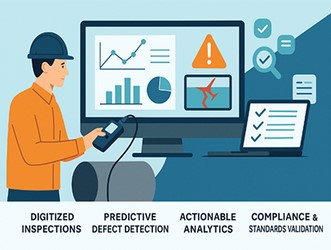
Our Non-Destructive Evaluation Examination Software transforms this critical inspection process into a fully digitized, predictive, and compliance-aligned workflow. By unifying inspection data, predictive defect analysis, and global standard validations under one platform, we enable proactive maintenance strategies, traceable inspections, and accelerated decision-making—minimizing risk while maximizing operational continuity.
Key Use Cases & Capabilities
1. Multi-Technique NDE Method Support
Supports Ultrasonic Testing (UT), Radiographic Testing (RT), Magnetic Particle Testing (MT), and Penetrant Testing (PT) seamlessly in one unified system.
Benefits:
-
- Centralized inspection data across multiple techniques
- Simplified training & certification compliance
- Faster cross-method correlation for defect validation
2. Predictive Defect Detection & Early Warning
AI-powered algorithms analyze inspection data to identify defect patterns, severity scoring, and potential failure progression.
Benefits:
-
- Early detection of high-risk anomalies
- Reduction in unscheduled downtime
- Proactive maintenance scheduling
3. Compliance & Standards Validation Modules
Pre-built validation engines ensure inspections comply with ASME codes, ISO 9712 standards, and industry-specific regulations.
Benefits:
-
- Real-time compliance alerts
- Reduced audit preparation time
- Lower liability exposure during inspections
4. Digitized Inspection Reports & Traceability
Complete elimination of paper-based reporting with real-time data capture via mobile devices and handheld scanners.
Benefits:
-
- Immediate report generation
- Full traceability for every inspection cycle
- Simplified data retrieval for audits & certifications
5. Centralized Defect Library & Knowledge Base
Continuously updated defect reference models, historical case studies, and standard defect categorizations.
Benefits:
-
- Standardized defect classification
- Consistent decision-making across inspectors
- Continuous improvement from historical trends
6. Visual Data Analytics with Heat Maps & 3D Visualization
Overlay inspection data on 3D models or asset diagrams for quick identification of risk zones.
Benefits:
-
- Visual clarity for maintenance teams
- Quick isolation of failure-prone zones
- Data-backed resource allocation for repairs
7. Integration with ERP & Asset Management Platforms
Seamless API-based integration with enterprise-level systems for synchronized operations.
Benefits:
-
- Unified asset health records
- Reduced data silos across operations
- Automated maintenance triggers based on inspection outcomes
Role-Based Access & Interfaces
Role
|
Key Actions & Interface
|
| Inspection Engineer |
Conduct inspections, log defect data, upload images |
| Quality Manager |
Review defect severity, approve inspection cycles, compliance validation |
| Maintenance Planner |
Schedule repairs based on defect risk scores |
| Compliance Officer |
Verify reports, track regulatory adherence |
| Admin |
Manage users, assign inspection permissions, configure compliance standards |
Before vs After – Problem Solving Matrix
Old Problem
|
New Digital Solution
|
| Fragmented paper-based inspection logs |
Fully digitized inspection data capture |
| Subjective defect interpretation |
AI-powered defect scoring and analysis |
| Reactive maintenance after failure |
Predictive maintenance based on early defect detection |
| Manual compliance validations |
Automated ASME, ISO 9712 compliance checks |
| Disconnected systems across inspection & maintenance |
Unified platform with ERP integration |
Analytics & Dashboards
-
- Asset Health Index across equipment
- Defect type frequency trends
- Inspector-wise performance analytics
- Real-time compliance gap alerts
- Inspection backlog & overdue reports
- Cost of deferred maintenance analysis
Use Case Impact – Real Industry Examples
Aerospace Component Manufacturer:
Reduced recurring structural failures by 35% using predictive defect alerts from early ultrasonic inspection data.
Oil & Gas Pipeline Operator:
Achieved 50% faster compliance audits with digitized reports aligned to ASME standards.
Heavy Machinery Fabricator:
Lowered unscheduled downtime incidents by 40% after shifting to predictive maintenance triggers via NDE analytics.
Why Choose This Solution?
-
- Comprehensive NDE technique coverage (UT, RT, MT, PT)
- Embedded ASME & ISO 9712 compliance engines
- AI-powered predictive defect analytics
- Visual 3D mapping for faster defect localization
- Role-based interfaces for inspectors, quality, and planners
- Seamless ERP, CMMS & asset management integrations
- Proven industry impact with measurable ROI
Get Started
Is your current NDE process reactive, manual, or fragmented? Discover how our Non-Destructive Evaluation Examination Software can help you shift from reactive firefighting to proactive asset health management.
Click here to schedule a demo